
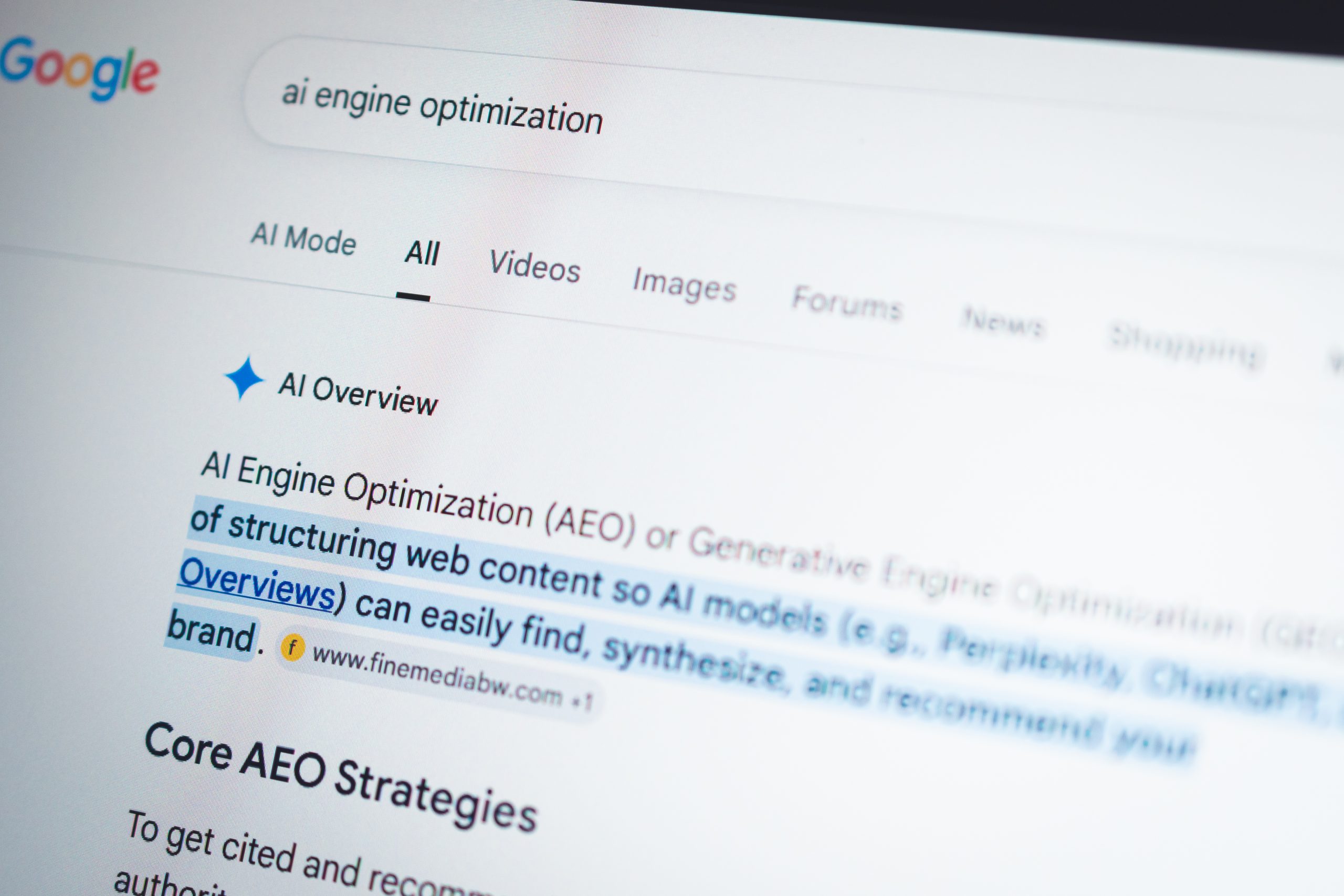
A prospect opens an AI assistant and asks which firms to talk to about rebuilding a multilingual website. They get a structured answer, three or four names, sometimes links. What they take away is a shortlist that either includes your brand or does not, along with a description of what you do that may or may not be accurate.
You do not control what a model produces, and no method will give you that control. You can act on what it finds when it looks: the pages you publish, what others write about you, and whether those accounts agree with each other. The work therefore starts with a question of fact. What do these tools currently say about your company, and what are they drawing on? Until someone checks, “we don’t show up in AI answers” stays an impression covering situations that are quite different from one another.
Mentions, citations, recommendations
Showing up covers at least three situations, and telling them apart changes what you go looking for. A mention puts your name in the body of the answer. A citation presents one of your pages as a source. A recommendation places your brand among the options offered to someone trying to choose.
They often overlap. A recommendation can carry a link to your site, which makes it a citation as well, and that link can produce a click you see in your analytics. A mention without a link leaves fewer traces, since it may shape a later search without your being able to follow the path. Which one matters most depends on the context and on what the person asking actually wants, not on a fixed order.
Two further situations are worth tracking separately, because they call for different fixes: the brand described inaccurately, and the absence on the questions you test.
GEO, or generative engine optimization, refers to the work of improving how a brand appears in these answers. Google takes the view that optimizing for its generative AI search comes down to optimizing for search, which is SEO, and its guide for site owners states that no special optimization is required to appear in AI Overviews or AI Mode. That position covers Google Search and not the other platforms, whose guidance differs.
Answers also come from different places. Some draw on what the model already learned and consult nothing live. Others retrieve pages from the web at the moment of the question, and the wording that surfaces your page is not necessarily the wording your prospect typed. Content that deals seriously with the real questions around a subject stands a better chance of being picked up than content built around one exact phrase.
Run a first diagnostic
Start by writing down the questions your customers ask before they buy. Your sales team knows which ones come back: the ones about what exists (“what software is there for scheduling field service teams?”), the ones about comparison (“field service software or an ERP module, how do you choose?”), and the ones about picking a supplier (“who can help us roll this out across our European sites?”). Fifteen or so is enough to begin, and that figure is a working benchmark rather than a validated threshold.
Keep the questions that name your brand in a separate set. They check whether what is said about you is accurate, while the others measure whether you can be found without the prompt. Mixing the two sets produces a flattering read.
For each run, note the date, the tool, the language, the market and the search mode. Record the brands mentioned, the links present, the sources and the factual errors. Start with the errors that concern information published on your own pages.
Come back to the exercise a few weeks later. Answers vary from one run to the next, even for an identical question, and a single observation will not teach you much.
What this record tells you is whether your offer is understood correctly, whether your pages let someone compare you, what information is missing, and which sources are speaking for you.
What to ask your web team to check
Before concluding that you have a content or reputation problem, rule out a block.
Are your important pages accessible and indexable? Check that the essential information on your pages is available, in text among other formats, and that crawling is not blocked.
Is an access rule blocking certain platforms? Several of them separate the crawler that feeds their search from the one used to train their models. OpenAI documents this distinction and states that a site opting out of its search crawler will not be shown in ChatGPT search answers, though it can still appear as a navigational link. Rules like these are sometimes added for sound security reasons, without anyone measuring the consequence.
Is your site allowed to appear in Google’s AI features? Since August 31, 2026, every site has a Search Console setting governing inclusion in Google’s generative AI features. Inclusion is the default, and a property can inherit the setting from a parent property.
Are your language versions declared correctly? Google documents how to signal the localized versions of a page.
None of these checks produces visibility on its own. They mainly save you from commissioning content to solve a configuration problem.

The content that answers buying questions
The content that earns its place here is the content that supports a decision: precise service pages, selection criteria, documented case studies, honest comparisons, answers to the objections your team hears every week, original data where you have it. None of this means giving up on style, since a page can be distinctive, well written and precise at once.
Google’s guide draws a line between generic content, which restates what plenty of people could write, and specific content, which brings experience or a point of view found nowhere else. No format guarantees a citation, though: not a word count, not an FAQ, not a particular heading structure.
Here is what precise looks like, in an invented example meant to show the editorial reasoning. On the services page of a company selling field service management software, you read: “We help our clients optimize their operations with a tailored solution and hands-on support.” The sentence is accurate, and it leaves the reader with nothing to compare.
A more useful version might read: “Our software schedules routes for teams of 10 to 200 technicians. Deployment takes three to six weeks and connects to the main ERP systems on the market. It is not a fit for organizations handling fewer than five jobs a day.”
Team sizes, deployment times, usage limits: a writer cannot produce these details. Someone has to collect them from the product, sales and customer service teams, then have them validated before publication. A richer brief produces a better page.
What others publish about you
Some of what is said about you does not come from your site. It comes from trade media, professional associations, partners who describe you on their own pages, expert publications, and the handful of directories people actually use.
Public relations does considerably more here than chase links. Its contribution lies in the information it puts into circulation: an argued position, sector data only you hold, an account of a project a journalist can pick up. Those publications keep circulating after they run and end up existing somewhere other than your own site. Media coverage does not translate into an AI citation, and Google notes that chasing inauthentic mentions works less well than it looks, since its spam systems apply to its AI features too.
Keeping published information consistent is less visible work and usually takes longer. A second invented example: a company narrows its offer, updates its site, and leaves a partner listing and an old press release online describing the previous business. During the diagnostic, an answer presents the company with that abandoned activity.
You then know two things. The description you got is inaccurate, and public pages carrying the old version are still online. What you do not know is whether those pages produced the answer, and their presence online is not enough to establish it.
Correcting them is still worth doing, since people read them and they surface in search results. Start with your own pages, then the profiles you control, then ask third parties for updates. Nothing guarantees that the assistants’ answers will change, or when.
Several languages, several markets
The questions people put to an assistant do not translate word for word. A buyer in Toronto, one in London and one in Sydney will phrase the same need differently and reach for different reference points, and a literal translation reproduces your phrasing rather than their usage. The same holds between languages. A French page and its English counterpart address readers who often arrive with different questions, and the version that works is the one written for its own audience.
That is not an argument for multiplying versions. One English article serves several markets when the substance is the same, provided you adapt the examples and reference points that genuinely change what the page is worth to the reader. Publishing near identical pages country by country mostly adds maintenance.
Setting your priorities
The same observation can have several causes. The table below offers a starting reading, to be confirmed by the checks in the second column.
| What you observe | Check first | Priority action | Expertise involved |
|---|---|---|---|
| The brand does not appear in the answers you test | That no access block explains the absence, and that your questions match the ones your customers ask | If a block exists, correct it where access is wanted. Otherwise, work out whether the gap is in the content available, its relevance, or your presence in the sources being consulted | Web, SEO, content or public relations, depending on what you find |
| The brand is mentioned but described inaccurately | Where the outdated information is published, how long it has been there, and whether it recurs across tools | Correct your own pages, then the profiles you control, then approach third parties | Content, brand and public relations |
| Competitors are cited from sources that never mention you | Which sources recur, whether they are relevant to your sector, and whether your absence comes from a gap in relationships or in publishable information | Produce verifiable information that gives those sources a reason to cite you | Public relations and content |
| The content exists but answers buying questions poorly | Whether your pages address selection criteria or mostly your own qualities, and whether the concrete details are there | Rewrite two or three key pages around the questions asked before purchase | Content and strategy |

Measuring visibility and its effects
Visibility, visits and conversions run together easily, and keeping them apart prevents a good deal of confusion in management meetings.
For Google Search, Search Console offers a generative AI performance report that counts impressions, meaning the number of times links to your site were shown in AI Overviews and AI Mode. The data breaks down by page, country, date and device. The report carries no click data: it tells you where you appear, without telling you what follows from it.
Visits show up partly in your analytics tool, when the referrer identifies the platform. A mention without a link can still prompt a later visit, though its part in that path is hard to measure. Conversions can be attributed where your tools allow it, which remains partial, since some journeys run through paths nothing identifies.
To that you can add your own tracking: presence in your sample of questions and the accuracy of what is said about you, recorded under the same conditions each time. These indicators stay internal and describe your tests rather than your market.
Where to start
Have a written diagnostic done before committing budget. Then fix what is both wrong and visible, followed by the pages that answer buying questions least well. Watch how it moves over a quarter before widening the exercise.
Several teams have a part in this. The questions to test come from sales, who hear them daily. The access checks belong to the web team. The missing information is gathered from product and customer service before anyone writes it up. Third party publications fall to public relations, and the consistency of what is said about you from one source to the next belongs to brand. Wink Strategies works with organizations across these areas and can take on all or part of the exercise. If you would like to talk it through against your own situation, get in touch.