
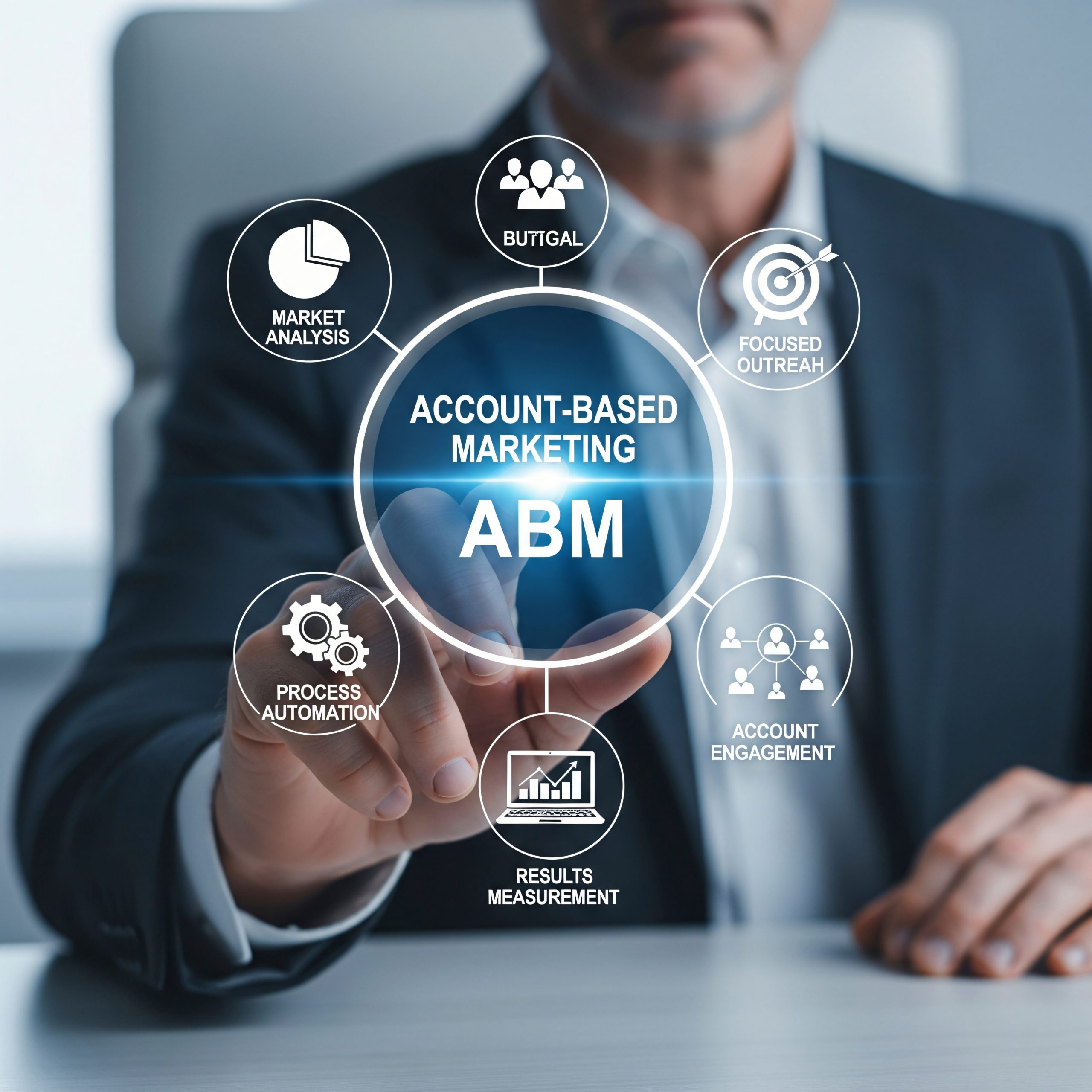
B2B marketing has undergone a paradigm shift. Gone are the days of casting a wide net hoping to catch a few qualified prospects along the way. Today, the highest-performing companies concentrate their resources on a portfolio of strategic accounts with ultra-personalized campaigns. This is Account-Based Marketing (ABM), an approach that can increase revenue by over 200% according to some studies.
But how do you effectively identify and reach the right decision-makers within these accounts? And most importantly, how do you automate this strategy without losing personalization? This article explores two essential dimensions of modern ABM: precise targeting through Account-Based Advertising, and the tool ecosystem that makes this approach scalable.
Targeting the Right Decision-Makers with Account-Based Advertising
The Principle: Laser Precision, Not Broad Brushstrokes
Account-Based Marketing rests on a simple but powerful principle: concentrate your marketing resources on a portfolio of specific accounts rather than scattering efforts across a vast audience. This focus requires tight alignment between marketing and sales, with both teams working around a shared list of strategic accounts.
Account-Based Advertising (ABA) refers to using digital advertising in this ABM spirit. Concretely, you dedicate your media spend exclusively to targeted companies and their decision-makers, with tailor-made messages. The results speak for themselves:
- +60% closing rate when ABM is aligned with targeted advertising
- +72% customer engagement compared to non-targeted marketing
- Reduced ad waste by targeting only high-potential accounts
Unlike mass-broadcast campaigns, ABA covers the entire buying cycle by targeting specific accounts. You buy ad impressions reserved for targeted segments, with personalized messages, then analyze results in terms of account engagement rather than simple clicks. The right metric is no longer CPC, but cost per engaged account.
Identifying and Mapping Your Target Decision-Makers
Why this effectiveness? Because in B2B, even though purchasing decisions are collective, committees are composed of individuals at different buying stages. It’s crucial to put the right content in front of each decision-maker.
To achieve this, follow this methodology:
1. Define Your Ideal Customer Profile (ICP) This is the foundation of any successful ABM strategy. Analyze your best current customers: what industries? What organization size? What common challenges?
2. Map Decision-Makers by Account Your internal data is a goldmine. Examine who you’ve closed your best deals with: what job titles recur? What roles in the buying process? This analysis helps you establish a typical decision-maker profile per account.
3. Enrich with ABM Data Tools Customer intelligence platforms can transform your raw data into concrete decision-maker names and contact details. Solutions like 6sense go so far as to link anonymous web signals (visits, intent) to known contacts in your CRM, transforming invisible data into actionable behavioral profiles.
4. Activate the Right Distribution Channels Once your targets are identified, use the quintessential B2B channels:
- LinkedIn Ads with Matched Audiences (targeting by company, function, and account list)
- Google Display for retargeting by company domain
- Highly selective email campaigns or InMails with high-value content

Content at the Heart of ABM: Personalization and Relevance
Content is the fuel of any ABM initiative. To captivate highly solicited decision-makers, your content must resonate with their specific priorities. ABM accelerates the sales cycle by targeting decision-makers with personalized content from the earliest phases, reducing time wasted on unqualified leads.
Hyper-personalized content captures their attention, builds trust, and positions your company as a strategic partner that understands their challenges. Focus on high-impact formats:
- Case studies illustrating successes with similar clients
- Customized infographics with data relevant to their industry
- Exclusive webinars on their specific business challenges
- Tailored white papers providing targeted solutions
Concrete example: For a technical decision-maker, a case study detailing how your solution improved performance for one of their peers will be highly compelling. For an executive, a VIP webinar on industry trends will create engagement.
This custom content serves as a thread throughout the buying cycle. In ABM, marketing and sales work hand in hand: marketing creates and personalizes content by persona, sales uses it at the right moment to restart the conversation. This synergy significantly increases the chances of converting the target account.
Essential Tools for Automating Your ABM Strategy
Deploying a sophisticated ABM strategy across all your strategic accounts is impossible without adequate technological support. Implementing ABM at scale requires the right technology—platforms that help identify high-intent accounts, engage them in personalized ways across multiple channels, and precisely measure results.
The ABM tool ecosystem rests on three pillars: personalized content, intelligent data, and automated orchestration. Here’s an overview of the essential categories.
1. Content and Personalization at Scale Tools
Content is the fuel of ABM, but continuously producing ultra-targeted content for different accounts can quickly become a bottleneck. Modern tools leverage AI to lighten this load.
AI Writing Assistants Solutions like ChatGPT, Jasper, or Copy.ai generate draft articles or white papers adapted to a given industry or persona in seconds. AI helps adapt the same content into multiple personalized variants without starting from scratch—by changing a few paragraphs to match the specific challenges of company X or Y.
Content Experience Platforms Solutions like Uberflip allow you to centralize, organize, and personalize content at scale, improving engagement throughout the buying journey. Concretely, these platforms create a content hub for each account: blogs, videos, case studies are gathered and presented dynamically based on the visitor.
Integrated AI recommends specific content to each decision-maker based on their profile and behavior, ensuring a highly relevant experience. These tools integrate with your CRM and marketing software, so that content viewed and interactions are tracked and actionable in your workflows.
Content Intelligence Tools These platforms analyze performance to guide you. They indicate which topics, formats, and messages work best for which type of account, based on engagement data. For example, you might discover that CFOs in industrial companies interact more with ROI calculators, while CIOs prefer technical white papers.
2. Behavioral Analysis and Intent Data Tools
Understanding when and what to engage a target account on makes all the difference. Behavioral analysis tools—boosted by AI—scrutinize signals left by your prospects to deduce where they are in their buying journey.
Advanced ABM Platforms Solutions like 6sense or Demandbase aggregate massive data volumes (web visits, searches, email interactions, social media…) to provide deep insights into each account’s behavior and intent. These tools detect which accounts show signs of active interest and can even predict which accounts are most likely to purchase soon.
The benefit is twofold: prioritize your efforts on “hot” accounts and personalize the message based on what precisely attracts their attention.
External Intent Data This is information gathered outside your ecosystem indicating that an account is actively searching for a solution like yours. Specialized services (ZoomInfo, Bombora, TrustRadius) detect this type of activity—for example, multiple employees from a company consulting product sheets related to your industry on a B2B marketplace.
Using this data gives a decisive competitive advantage: you can intervene at the right moment with a highly relevant message. LinkedIn even allows integrating these intent-based audiences into Campaign Manager to retarget these hot accounts with advertising.
Real-Time Dashboards These tools provide a 360° view of each account: how many decision-makers interacted this month? On what content? Are they showing advancement signs (visiting the pricing page, etc.)? Metrics like number of engaged accounts, engagement level per account, or intent scoring become more meaningful than individual leads.
This data-driven approach helps you continuously adjust your orchestration, for example by triggering direct sales action when an account reaches a certain engagement score.
3. Personalized Distribution and Multichannel Orchestration Tools
The third pillar concerns orchestrating and distributing your ABM campaigns across appropriate channels, in an automated and individualized manner. The goal: each account receives the right message, through the right channel, at the right time.
ABM Orchestration Platforms Solutions like Terminus, RollWorks, HubSpot ABM, or Demandbase act as control towers from which you pilot coordinated campaigns across multiple media:
- Display advertising targeting accounts (social networks, web banners)
- Segmented email campaigns
- Website personalization for visitors from targeted accounts
- Content delivery or event invitations
For example, Terminus offers a complete range for executing cross-channel ABM campaigns—account targeting, personalized ads, dedicated web experiences, prospecting support tools—all measured end-to-end.
Website Personalization Rather than displaying an identical website to everyone, adapt the experience when a visitor from a target account arrives. Personalization solutions can recognize a visitor’s company domain and present a different homepage mentioning their industry, or highlight case studies relevant to their sector.
According to Demandbase, it’s now possible to identify accounts visiting your site and adjust almost every word to each one’s needs. A banking sector decision-maker will see an infographic on financial compliance challenges, while a healthcare visitor will see a video on medical regulations—each having a web journey tailored to their concerns.
Marketing Automation Solutions like Marketo, HubSpot, or Pardot allow you to build conditional workflows triggered by prospect behavior. For example, if an IT manager from account X clicks on a LinkedIn ad leading to a white paper, the tool can automatically add them to a specific email sequence or notify the assigned sales rep.
These platforms automate content delivery and account engagement tracking, ensuring each account receives relevant follow-ups without everything being done manually. They also manage commercial pressure (to avoid bombarding the same contact) and scoring.
CRM/Marketing Automation Integration: Critical Success Factor
Your ABM tools must mesh with your existing ecosystem to ensure continuous data flow between marketing and sales. The sales team must see, in the CRM (Salesforce, HubSpot CRM…), the content viewed and engagement history of their accounts, to further personalize their approach.
Conversely, field feedback from sales must flow back to the marketing platform to adjust campaigns. Market solutions generally offer native integrations with leading CRMs and automation tools, so ABM adoption doesn’t require a technical revolution.
When this integration is well executed, you avoid data silos and ensure fluid communication between teams. Concrete example: if a key account registers for your webinar (data captured by your marketing tool), the assigned sales rep can be alerted immediately via CRM and prepare proactive follow-up.
ABM as an ROI-Oriented Marketing Discipline
A successful ABM strategy relies on a winning trio: personalized content, intelligent data, automated orchestration.
Content acts as a value vector to engage decision-makers on what truly matters to them. Behavioral analysis and intent tools, AI-powered, tell you who to target, when, and with what message. Finally, automation and distribution platforms ensure this hyper-targeted message reaches its audience via the optimal channel, while measuring impact in real time.
For B2B and SaaS marketing leaders, this means the ability to scale ABM without diluting personalization. The professional, ultra-relevant tone you’ll employ in these campaigns, supported by these modern tools, will hit the mark with the decision-makers you’re pursuing.
By investing in these approaches and technologies, you give your ABM strategy a decisive competitive advantage: always being in the right place, with the right content, for the right people. This isn’t a passing trend, but an ROI-oriented marketing discipline focused on long-term customer relationships—an approach no B2B marketer can now do without.